
Lafayette County Court Records After a Jail Arrest
After a Lafayette County jail arrest, the court-record path runs separately from the jail-custody path. The jail can confirm whether someone is in custody by phone, but the formal charges, case number, hearing dates, filings, and outcome live with the Lafayette County Clerk of Court and the Third Judicial Circuit. The Office of the State Attorney reviews the arrest and decides what to file, and that filing is what creates the court record for the case. So a court-records search after an arrest is really a search of the clerk's case index.
The arrest side and the court side answer different questions. For custody, booking detail, and how someone got into the jail, the jail inmate records page covers the roster and records-request route, and the jail mugshots page covers booking photos. This page stays on the court record itself, the charges the prosecutor filed and how the case moves through the court after the arrest.
How to Find Lafayette County Court Records After an Arrest
Lafayette County court records are searched through the Clerk's online court-records portal, run on the CiviTek OCRS system. The clerk's online services page links the court-record search, and the portal offers public anonymous access along with credentialed access for attorneys, registered users, and parties. Public access lets anyone search the case index, though some documents are limited.
The Lafayette County Clerk online services page is the official starting point and links the court-record search alongside official records and e-filing tools.
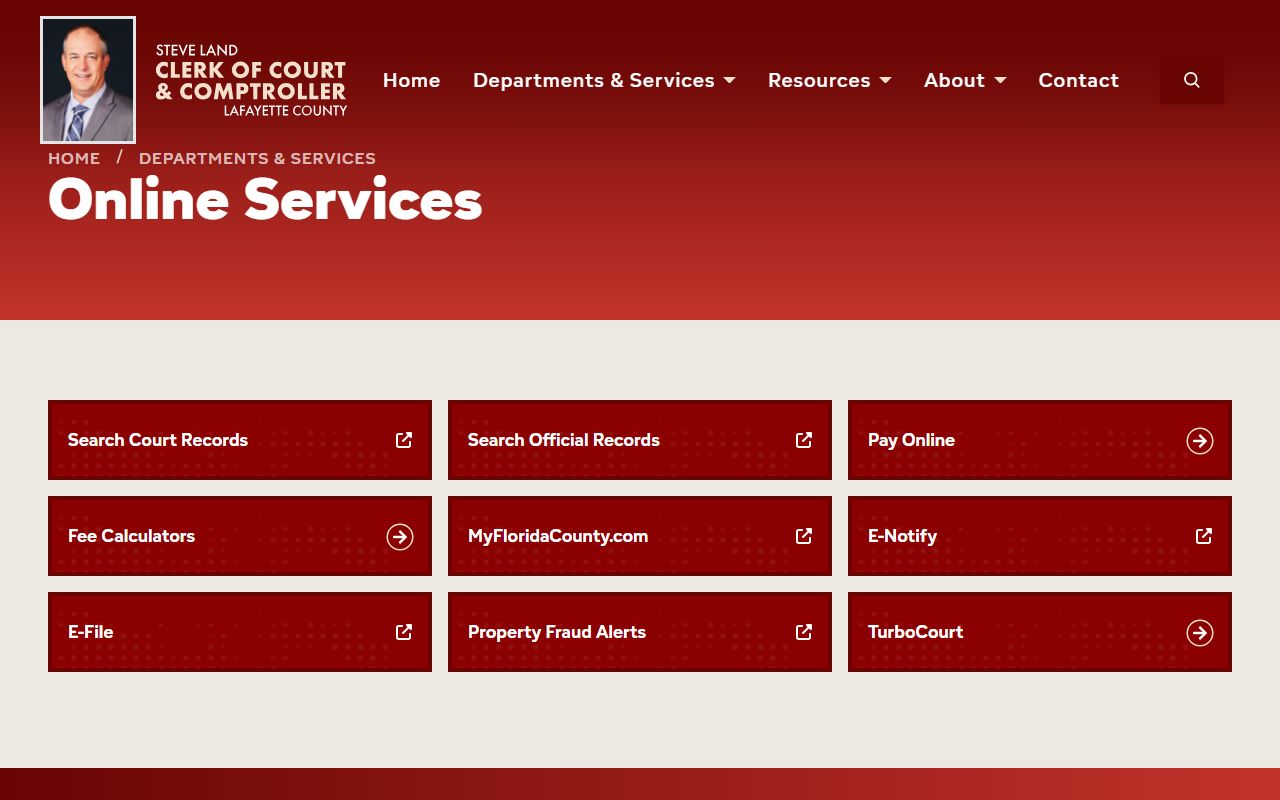
From that page, the Search Court Records link opens the OCRS portal where the charges and case status appear. The steps below move from the portal to a specific case.
- Open the Lafayette County OCRS portal and choose Public access.
- Search by the defendant's last name, or by year, court type, and sequence number for an exact case.
- Open the case and read the charge list, the filing, and the docket entries.
- Check each charge's code, level, and current status, and compare it to the original booking charge.
For statewide criminal-history records rather than a single county case, Florida's criminal-history system is run by the state and is separate from this county court index.
How Charges Get Filed After an Arrest: Complaint, Information, and Indictment
The court record begins when a charging document is filed, which is a step after the jail booking. Under Florida Rule of Criminal Procedure 3.140, capital crimes are charged by grand-jury indictment, while other felonies and county-level crimes can proceed by information or indictment. In practice, the State Attorney files an information for most felonies after reviewing the arrest, so the charge in the court record can differ from the charge at booking.
| Complaint | Information | Indictment | |
|---|---|---|---|
| Filed By | Officer / Prosecutor | State Attorney | Grand Jury |
| Common For | Initial / lower charges | Many felonies | Capital and serious felonies |
| Starts | The early case | The court case | The court case |
The prosecutor serving Lafayette County is the Office of the State Attorney, Third Judicial Circuit, led by State Attorney John F. Durrett. The circuit covers Columbia, Dixie, Hamilton, Lafayette, Madison, Suwannee, and Taylor counties, which is why Lafayette prosecution records route through a circuit office rather than a Mayo address.
Charge Status and What It Means
Charges are not fixed once a case opens. A prosecutor can amend, reduce, add, or drop charges, and a judge can dismiss them. The booking charge on the arrest record can also differ from what finally gets filed. The common status terms below show up in the court record as the case moves.
| Status | What It Means |
|---|---|
| Pending | The charge has been filed and the case is still active in court. |
| Amended / Reduced | The charge was changed, often to a lesser offense, after review. |
| Dismissed | The court dropped the charge and it is no longer being pursued. |
| Nolle Prosequi | The prosecutor decided not to pursue the charge. |
Note: Circuit Court handles felonies while County Court handles misdemeanors and criminal traffic, so a single arrest can produce cases under different court types in the index.
Bond and Release After an Arrest
Bond decides whether a person waits out the case in jail or at home. Before the first court date, a uniform schedule may control whether a preset bond can be posted. The Third Judicial Circuit's AO 2025-002 uniform bond schedule applies across the circuit, including Lafayette County, before the next scheduled first appearance, and it does not bind the judge at first appearance. At first appearance the judge can review probable cause, advise rights, and set release conditions, which may be a money bond, nonmonetary conditions, release on recognizance, or no bond.
| Bond Type | How It Works |
|---|---|
| Cash Bond | The full amount is posted directly to secure release. |
| Surety Bond | A licensed bail agent posts the bond for a fee. |
| PR / Recognizance | Release on a written promise to appear, with no money posted. |
| No-Bond Hold | Detention where no posted bond is currently available, often due to a hold. |
A hold can keep someone in custody even after a local bond is posted. Examples include a warrant from another county, a probation violation, or a state or federal hold. Local bond-posting hours and methods were not published, so confirm them with the jail at 386-294-4381 and check the court case for bond entries.
Warrants That Lead to an Arrest
An outstanding warrant is a common reason a booking happens at all. Lafayette County does not publish an online warrant search or an active-warrant list. The sheriff FAQ gives the official method, which is to call or come into the sheriff's office and request a warrant check, with warrant questions handled at 386-294-1222. A related court case or a failure-to-appear entry may also show up in the OCRS court index, though there is no separate warrant tab.
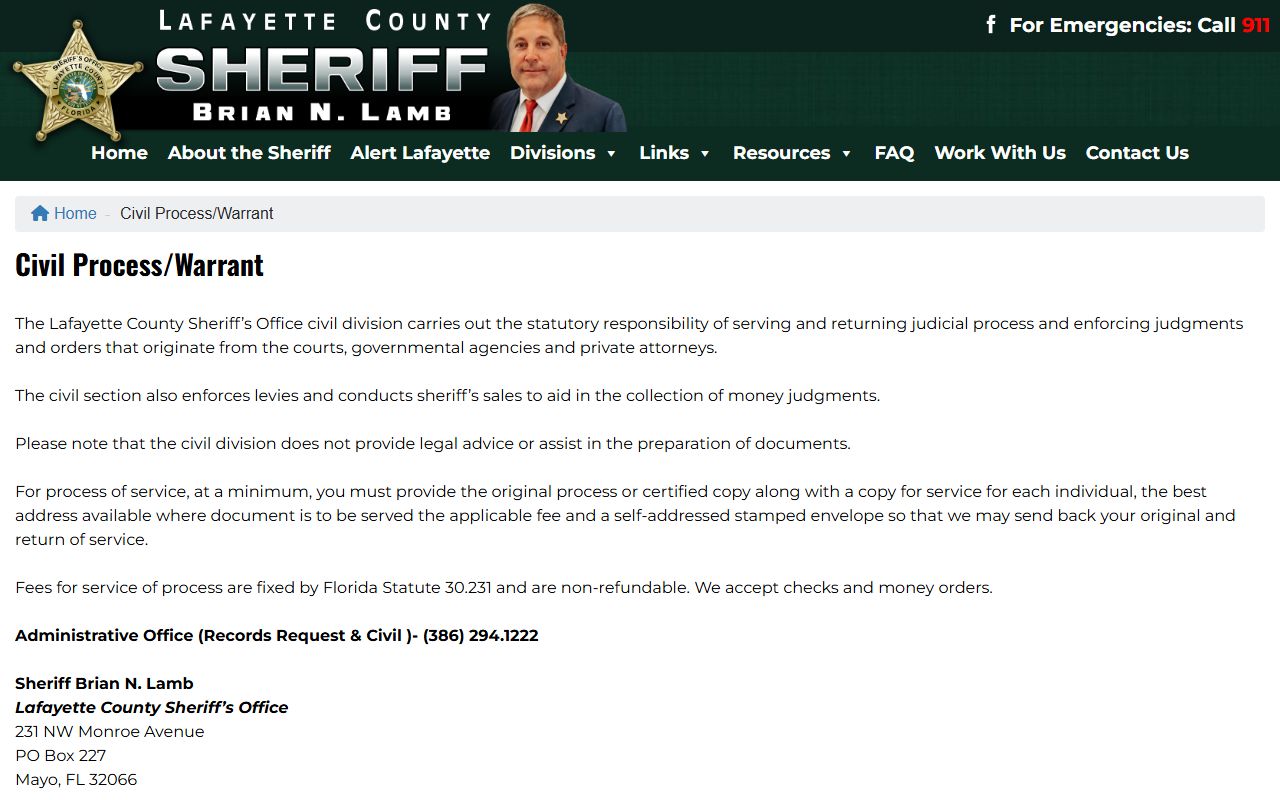
The Lafayette County Sheriff Civil Process and Warrant page describes service of judicial process but does not provide a public warrant roster, which is why a phone or in-person check is the route.
A real example shows how this works. An FDLE release dated April 17, 2025 noted that the sheriff located a man during a traffic stop after an arrest warrant and booked him into the Lafayette County Jail without bond, a path that started with a warrant and ended in a court case.
Public Records From the State Attorney
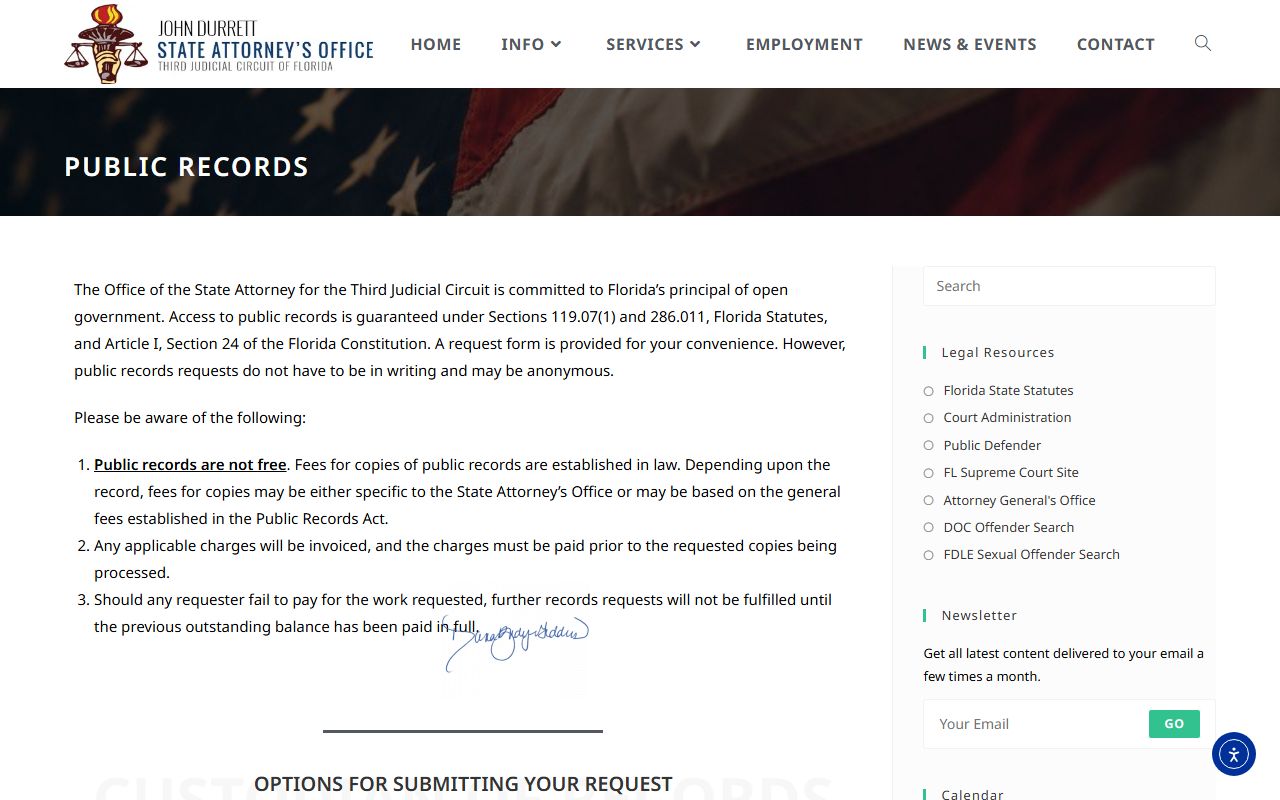
The prosecution side of a case has its own records process, separate from the clerk's court file. The Third Circuit State Attorney's public-records page says a request does not have to be in writing and can be made anonymously, with the office reachable by phone, in person, by mail, or through an online form. The only required field on the online form is the request itself, though the office warns that without a delivery method it cannot send the records back. Pickup options listed include Live Oak, Lake City, Cross City, and Perry.
The records custodian for the office is Dana Brady-Giddens, reachable at 386-362-2320, and fees set by law may apply. Charges are invoiced and must be paid before copies are processed, and an unpaid balance can hold up future requests.
So a full picture of a case after an arrest can draw on two sources: the clerk's court file for the charges and docket, and the State Attorney for prosecution records.
Charges vs. Convictions
Being arrested and charged is not the same as being convicted. A charge is an accusation that opens the court record; a conviction is the outcome after a plea or a verdict. Both can appear in public records, but they carry very different weight, and an open charge can still end in a dismissal.
| Charge | Conviction | |
|---|---|---|
| Stage | Accusation | Verdict or plea |
| Burden of Proof | Probable cause | Beyond a reasonable doubt |
| Public Record | Yes | Yes |
Sealed vs. Expunged Court Records After an Arrest
Florida law lets eligible records be cleared after an arrest, through two different paths. A sealed record is hidden from public view but still exists for limited official use. An expunged record is destroyed and treated as though it never happened, with very limited access. The court-ordered routes are set by Florida Statutes § 943.059 for sealing and § 943.0585 for expunction, and not every arrest qualifies.
| Sealed | Expunged | |
|---|---|---|
| Visibility | Hidden from public | Destroyed / treated as never existed |
| Law Enforcement | Limited access | Very limited access |
| Florida Statute | § 943.059 | § 943.0585 |
Eligible records may be sealed or expunged by court order under those statutes, but eligibility rules apply, so the court order and the originating agency control what actually gets removed.
Background Check Considerations
A casual court-record lookup is not the same as a regulated background check. An FCRA-compliant background check follows federal rules for credit, employment, housing, and similar decisions. The court index and the search tools on this site are not that, and they should never be used to make those decisions.
Important: This site is not a consumer reporting agency under the FCRA, and its information may not be used for credit, employment, housing, insurance, or any other FCRA-covered purpose.
Restricted Court Records After an Arrest in Lafayette County
Not every court record after an arrest is visible online. The clerk's court-services material flags juvenile and mental-health records as often confidential, and sealed or expunged cases are removed from public view. The OCRS portal also limits some documents by access level, since a member of the public may see a docket while an attorney or party account can see more. Online access to the records is governed under Florida AOSC 16-107, and the clerk's office handles user-ID and password questions for the credentialed paths.